
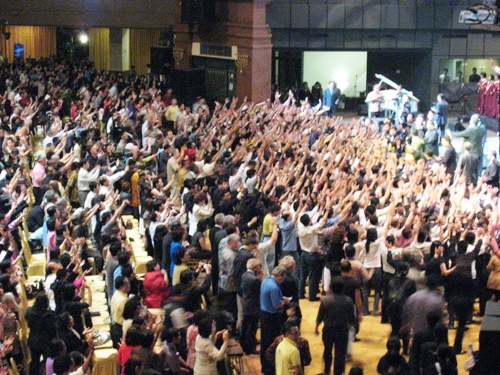
The study of doctrine and theology has declined in God’s visible church over the last few decades at an alarming rate. An ever-increasing number of churches have adopted a seeker-centric approach to ministry in lieu of sound biblical teaching. According to so-called church growth experts, the unchurched masses are generally open to believing in God and accepting Christ. It is the church as an institution that drives them away from commitment. This type of person is called a ‘seeker’. In order to get these people to come to church and make that saving commitment church leaders must lure them in by appealing to their flesh. Learning theology and doctrine doesn’t interest them so it is laid aside as a primary ministry of the church. In other words, entertainment in all of its forms: music, dramatic performances, movie clips, light shows, media montages, etc. can be utilized to make the church a more comfortable, less intimidating place for seekers to find refuge. Psychological manipulation replaces the preaching of the word as a means to salvation. Sermons are often centered around felt-needs messages that ‘meet people where they are at’. Ministers may preach on topics such as strengthening marriages, gaining financial freedom, finding a stress-free lifestyle, even having a better sex life. This is all done to ‘ease’ the seeker into the fold before presenting him the gospel. It is a sandy foundation which collapses upon close scrutiny. Continue reading
Tag Archives: Church Growth
One Month to Live
Note: Don’t be alarmed. The post title refers to a book, not my current state of health.
Last month I put out a post asking for book recommendations for a summer reading program one of our church deacons is starting up this summer to encourage reading in our congregation. Of course, we visualize taking up sound biblical materials. My leanings are towards theological works that have been well established – Christian classics. I submitted a fine list of books that aren’t heavy, dry or technical, written by a wide variety of well respected (and theologically orthodox) writers. Well, in a nutshell, my picks were shot down before they could take flight. My deacon friend doesn’t believe most people (that is, believing Christians in the church) will be interested in theology! This boggles my mind, frankly. I consider myself an ordinary fellow of average intellect. Yet, I have an unquenchable yearning for the knowledge of God. This comes from God’s call upon me to become his own possession, a beloved child in his vast, ever-expanding family. As such, I desire to know this God who has rescued me and washed me clean of all my sins. The doctrine of the bible is for the simple and unlearned as well as for the towering intellectual. Theology is not at heart a purely academic pursuit. It is the pursuit of God Almighty. I have a hard time grasping the concept that true believers don’t desire the same things. My yearning may be at a high level because of the calling on my life to teach eternal truths, but surely every believer wants to intimately know the God who saved them to some degree. Every Christian most certainly needs this knowledge to grow in the grace whereby they are saved.
Of course, I know where the deacon’s line of thinking stems from. It has flooded modern evangelicalism for decades now. The church growth\seeker-sensitive movement thrives on a non-doctrinal paradigm of Christian pragmatism. Don’t give church-goers what they need, give them what they want – in liberal doses. This pragmatic approach may attract multitudes of church-goers but does little to produce true disciples of Christ. So the wants of a typical church filled with ‘seekers’ (those who haven’t made any kind of commitment to Christ but are interested) do not match those in the church who are truly Christians. The focus of seeker-sensitive churches sits squarely upon the seeker and his carnal wants instead of the classic doctrines of the bible: teachings such as man’s sinfulness, God’s wrathful judgment against sin, the means of salvation and sanctification he has provided through Christ’s atoning work on the cross and the heart-changing ministry of the Holy Spirit. I suppose congregants who have no zest for doctrine and theology are considered ‘babes in Christ’ who need to be nurtured in a pastel colored nursery by coochie-coochie-coo care-takers that speak condescendingly about moral platitudes from the life of King David. Unfortunately, seeker-sensitive churches often have no plans to move toddlers out of the nursery. They keep them content with toys and entertainment. Continue reading
State of the Church Address
John MacArthur states hard truth as boldly and earnestly as anybody out there. He pulls no punches in this article on his Grace to You blog. I agree with his assessment 100%. A great read.
Speaking of MacArthur and modern Evangelicalism, he has now published a third edition of his outstanding hard-hitting exposé on contemporary church-growth methods, Ashamed of the Gospel. Available at Monergism Books. Highly recommended.

A must read for those struggling with the direction of today's church
Absurdity of the ‘Seeker Sensitive’ Movement Illustrated
From the Sacred Sandwich:

Is it the duty of pastors to make God and His Holy Word more palatable to the masses? This satirical ad demostrates the inanity of the concept.
Spurious Conversions
 “In the church where I ministered in South Wales I used to stand at the main door of the church at the close of the service on Sunday night, and shake hands with people as they went out. The incident to which I am referring concerns a man who used to come to our service every Sunday night. He was a tradesman but also a heavy drinker. He got drunk regularly every Saturday night, but he was also regularly seated in the gallery of our church every Sunday night. On the particular night to which I am referring I happened to notice while preaching that this man was obviously being affected. I could see that he was weeping copiously, and I was anxious to know what was happening to him. At the end of the service I went and stood at the door. After a while I saw this man coming, and immediately I was in a real mental conflict. Should I, in view of what I had seen, say a word to him and ask him to make his decision that night, or should I not? Would I be interfering with the work of the Spirit if I did so? Hurriedly I decided that I would not ask him to stay behind, so I just greeted him as usual and he went out. His face revealed that he had been crying copiously, and he could scarcely look at me. The following evening I was walking to the prayer-meeting in the church, and, going over a railway bridge, I saw this same man coming to meet me. He came across the road to me and said, ‘You know, doctor, if you had asked me to stay behind last night I would have done so.’ ‘Well,’ I said, ‘I am asking you now, come with me now.’ ‘Oh no,’ he replied, ‘but if you had asked me last night I would have done so.’ ‘My dear friend,’ I said, ‘if what happened to you last night does not last for twenty-four hours I am not interested in it. If you are not as ready to come with me now as you were last night you have not got the right, the true thing. Whatever affected you last night was only temporary and passing, you still do not see your real need of Christ.’ That is the kind of thing that may happen even when an appeal is not made. But when an appeal is made it is greatly exaggerated and so you get spurious conversions”. – Martyn Lloyd Jones
Changing the Heart of Worship
I’ve observed a trend over my 12 years as a member of Christ’s body that has increasingly raised my ire. Worship leaders have been exercising their freedom to change hymn and praise & worship song lyrics that they don’t care for. For example, I recently heard of one such worship leader who didn’t like a particular verse in the popular song ‘The Heart of Worship.’ Here is the offending verse:
King of endless worth, no one could express
How much You deserve
Though I’m weak and poor, all I have is Yours
Every single breath
The worship leader bristled at the thought that people are weak and poor, so he desired to alter the lyrics a bit to reflect a more positive, self-affirming view of fallen man. He wanted to change the line to: Continue reading
Do We Really ‘Decide’ For Christ?
Here is a clip from a CrossTV series investigating the modern evangelical tactic of moving people to ‘make a decision for Christ.’
Road to Reformation – Part 2
I actually read most of the best-selling book, “The Purpose-driven Life” a couple of years ago. At the time I thought it was a refreshing blast of gospel simplicity. I was thrilled at Rick Warren’s approach because, in hindsight, it was reflective of the way my church conducted service. It was a natural synopsis of the philosophies I had been raised upon in my first decade of spiritual growth. Of course I loved it! I heartily recommended it to a friend struggling through a divorce for encouragement, without a moment’s hesitation.
However, my suspicions concerning the state of the modern evangelical church continued to grow from that time until just over a year ago. It all came to a head in a prayer I voiced to God in the cool darkness of my backyard one late autumn night. My prayer went something like this: “Lord, my spirit is troubled over the church and the way it is handling the precious gospel of our Savior, Jesus Christ. I can’t quite put my finger on it, but I fear that error is spreading like a plague through the churches of our land. More than anything, I desire to know the truth, and to live by that truth no matter the personal cost. Humble me that I may choose to follow you, Lord wherever it is you lead me. Open my eyes that I may perceive, unstop my ears that I may comprehend.”
Road to Reformation – Part 1
For 10 years I cruised down the smooth asphalt highway of free-will theology. Gradually I began to take notice that the pristine world scrolling past my vision started to lose its luster. The rolling green hills and bright blue sky had become washed out, dull and lifeless; a barren winter landscape. It was then I noticed it wasn’t the environment that had changed, but it was the Lord removing the rose-colored spectacles perched on the end of my nose. Spectacles, that up to that point in my spiritual walk, I had been blissfully unaware I was even wearing. For the first time in my born-again life I saw the modern church from a perspective outside my own limited worldview. I began to question doctrines and church traditions I had firmly believed in for a decade. I marveled at methodologies that didn’t spring from the pages of scriptures, but were fermented in the minds of well-meaning modern evangelicals. Thump! Thump-Thump! Where did all these potholes come from! Oh my. This highway, I’ve discovered, has a toll booth. The price, I fear, is too high to pay. Continue reading
 A Peculiar Pilgrim